


Two weeks ago, I spoke to a high school cross-country team prepping for their season opener. The presentation I gave was one I built almost ten years ago and have refined and enhanced since. With most teams gearing up for cross country seasons, it seemed worth putting on paper and sharing with this audience.
All of this information is what I would share with my sixteen-year-old self. Most of it I still remind professional runners.
Consistency Beats Perfection
Runners mostly dream about who they could be on their perfect day. Focus instead on raising your average day. You will have far more of these.
The goal is to shrink the gap between your best day and your worst. Build the habit of giving real effort regardless of the circumstance: the weather, the sleep you didn’t get, the workout that started badly. If you can’t be great, aim to be solid. You ultimately raise your ceiling by raising your floor.
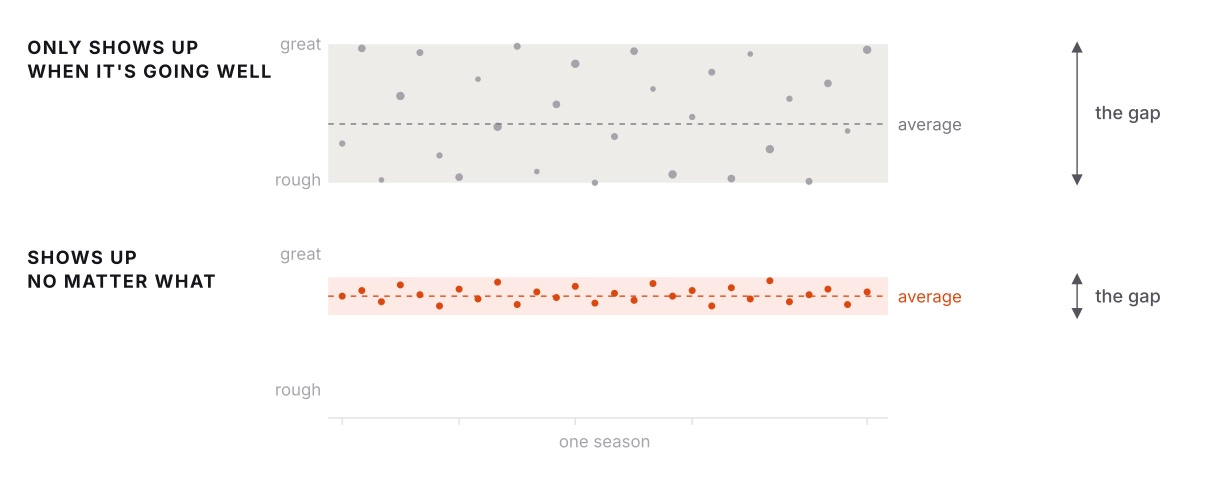
Stringing together ordinary weeks is not exciting, but it’s the largest source of momentum available to you. In a five-year study of elite Australian track and field athletes, those who completed more than 80% of their planned training weeks were seven times more likely to hit their performance goals. Excellence isn’t built on one heroic effort. It is built on hundreds of ordinary days where you could have cut corners but didn’t.
Trajectory Matters More Than Position
If the first workout or race of the season doesn’t go the way you wanted, be careful not to judge it too early. The season is long, and a lot can change. We expect improvements to be linear and then get discouraged at the first sign of a plateau. Everybody has dips and regressions. That is what development actually looks like. We overestimate what we can do in one week and underestimate what we can do in a year. Be patient enough to stay the course, even through the unexpected detours.
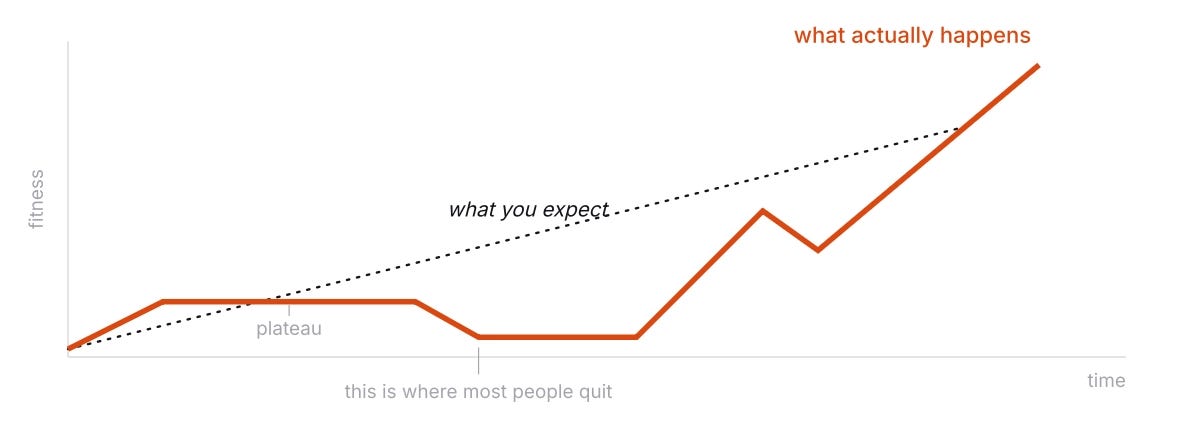
Your starting point tells you almost nothing about your slope of improvement. How good you are today is largely unrelated to how much you will improve. Potential isn’t just about where you start; it’s how far you can travel.
Belief is a physiological variable
The scientific literature on the placebo effect tells us something uncomfortable: expectation alone changes physiological outcomes.
One study I cited in this newsletter tested cyclists over a series of 10-kilometer time trials. Before each effort, researchers handed them a capsule and told them it was either a placebo or a low- or high-dose of caffeine. In truth, they were all just sugar pills.
The results were astonishing. When cyclists believed they’d ingested a high caffeine dose, their power output jumped by over 3%. When they thought they’d taken a low dose, the gain was smaller (around 1%). And when told it was “just a placebo”? No improvement at all.
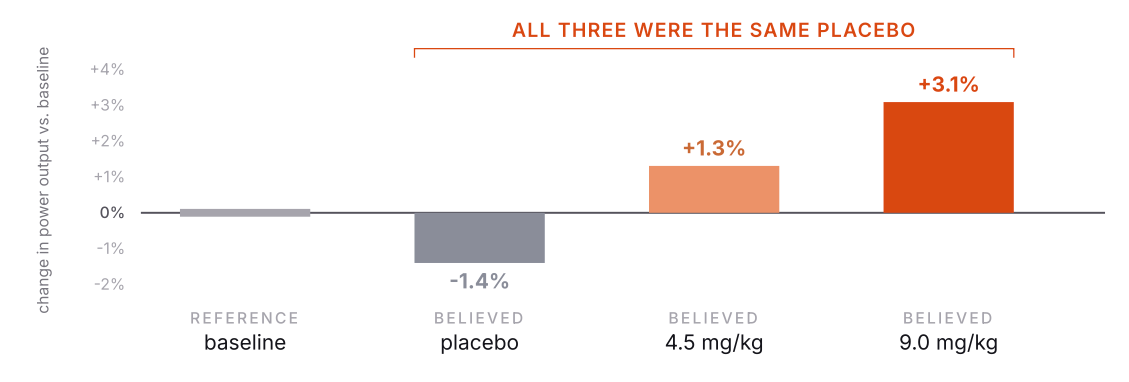
Belief in the program and belief in a coach amplifies or dampens the training stimulus. Two athletes can run identical workouts and adapt differently based on what they thought it would do for them. I recently saw a sign that read, “In a world where you can be anything, be kind.” I’d adapt that slightly for running. In a world where you can do anything, believe. There is no downside.
Culture is What The Team Does When Nobody Is Watching
Running only for yourself makes it easy to find an excuse. Running for your teammates usually finds you a gear you didn’t know you had. Talent can help a team win once. Culture is what sustains it. I have been part of many teams and have noticed the traits that promote excellence and the viruses that infect culture.
Shared traits of excellent teams
Humility and accountability: Nobody is too big to do the little things well. No double standards between the best runner and the last runner.
Push from the bottom: The motivation of the least fit runner has an outsized impact on team performance. Most people look to the team’s top runner as a litmus test of culture. I’d rather measure how far its last runner is willing to go.
Dream the right dream: Rehearse the hard days. The days when you feel great will take care of themselves. Nobody plans for the hard days, and those are the only ones that actually require a plan.
Traits of weak team cultures
Entitlement: Ambition is the act of closing the gap between your circumstances and your expectations. Entitlement is expecting others to close that gap for you. Nobody owes you anything. All success is earned, not given.
Supervised Compliance: Character is what you do when the coach isn’t looking. Culture is what the group does when the coach isn’t looking. Great teams don’t need babysitting. The drive comes from within.
Losing the narrative: Bad culture spreads fastest when it’s disguised as humor or nonchalance. Complaining, blaming, and excuse-making are all ways of handing ownership to somebody else. Misery loves company. Be intentional about what you say. Words are contagious.
Your Lifestyle is a Training Variable
Most runners talk about improvement as something that happens almost entirely within the two hours at practice. But in reality, nearly all of the adaptation happens in the other twenty-two.
You don’t have a training life and a real life. Your body is one integrated system. Good racing depends on good training, which depends on a good lifestyle. When races go badly, everyone scrutinizes the link between the training and the race. Almost nobody examines the link between the lifestyle and the training, which is the more consequential of the two.
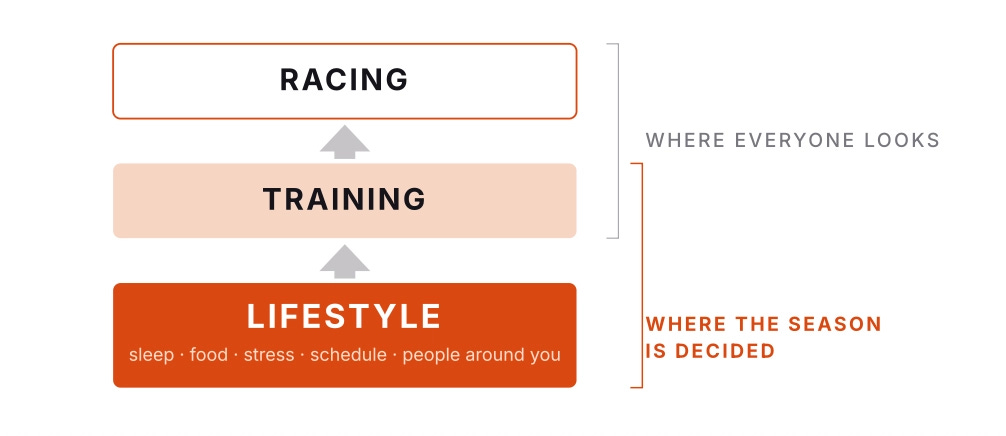
Race day isn’t just about wanting it more than the next person. Success in a race hinges on how you have designed your average Tuesday. If you don’t define your priorities, the world will do it for you, and it will pull you towards mediocrity. Ordinary inputs don’t produce extraordinary results.
Recovery Is Simpler Than You Think
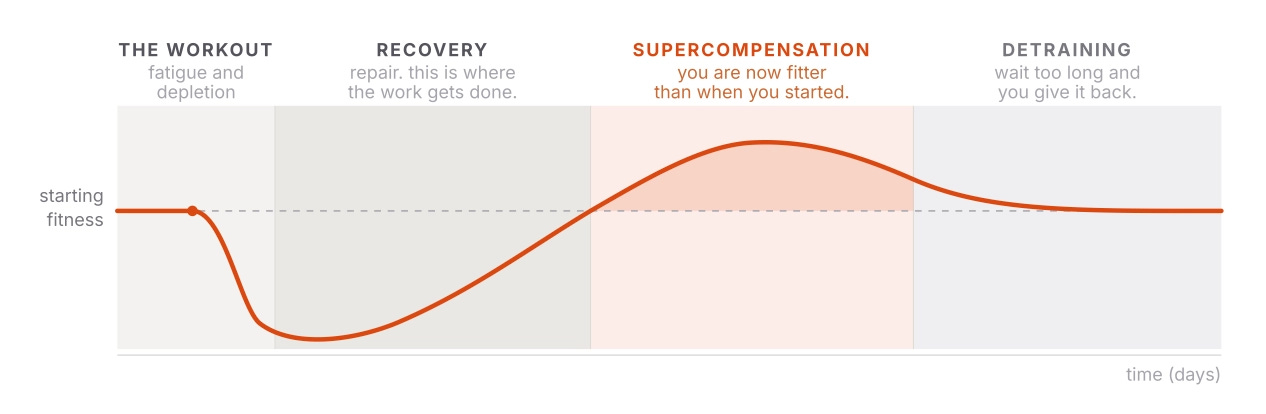
The only training you benefit from is the training you can recover from. Your fitness doesn’t improve during the workout itself. You finish damaged, depleted, and dehydrated. The adaptations happen when you recover and rebuild. The useful part is that you don’t just rebuild to your old baseline. Your body builds back with a margin. That process is called supercompensation, and is why training works at all.
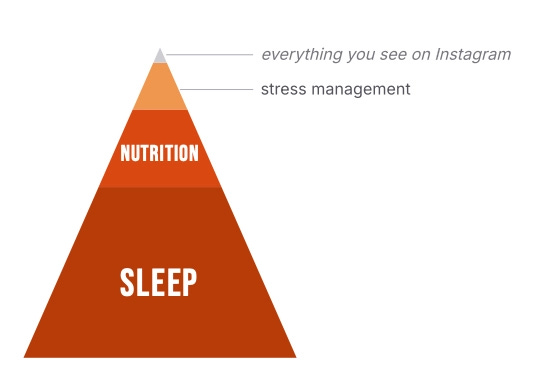
So what actually drives good recovery? Sleep, nutrition, and stress management are 80% of it. You simply can’t “out-train” bad sleep or poor fueling. Most people know this, yet few people do it once it’s no longer interesting. After that, we become preoccupied with the latest novel idea, shiny object, or gadget. While the recovery industry will evolve indefinitely, remember that every minute spent on a low-yield recovery strategy is a minute not spent on an evidence-based strategy that works. Nail the basics before you get fancy.
Eat Enough. Always.
I had three bone injuries in high school that cost me multiple seasons. I’m fairly certain I could have prevented them if I’d understood the link between nutrition and bone health.
Your body runs on a strict budget, and calories are your currency. You need to eat more than your basal metabolic rate plus the cost of your training. When you don’t, the body funds the organs that keep you alive and makes cuts elsewhere. Bone rebuilding, tissue repair, and reproductive health are the first line items cut. That’s a primary reason why chronic underfueling shows up as stress fractures, amenorrhea for women, and low testosterone for men.
If you’re going to miss, miss on the high side. The “risk” of being slightly overfueled is not in the same category as the risk of being underfueled. One of the better predictors I’ve found of a long-running career is how much food is on an athlete’s plate. The ones who skimp don’t last.
Listen To Your Body
We’ve gotten so reliant on wearables that we’re going numb to what our bodies are trying to tell us. The best tool for guiding your runs is between your ears, not what’s on your wrist.
Just because something can be measured doesn’t mean it should be. We’ve quantified and gamified recovery to the point where recovery has become more work, which is the opposite of rejuvenating rest. Use readiness scores to sharpen your intuition, not to replace it. A wearable earns its place when you use it to answer a specific question. Without a specific question, you’ll drown in data and easily mistake noise for signal. As Seneca put it, if you don’t know which port you’re sailing to, no wind is favorable.
Harder Is Not Always Better
Runners tend to be insecure overachievers. Most walk into a workout as if it’s an audition, a chance to prove their fitness is real. That is training to prove fitness rather than training to gain fitness. The distinction sounds like semantics, but it’s far more important.
The traits that carry athletes to the top are the same traits that push them over the edge when nothing checks them. A workout is supposed to create a stimulus that you can adapt to, not the hardest thing you can survive. However, the default setting is to always make a session 20% harder and to make it occur 20% more frequently. Most runners are so afraid of doing too little that they overshoot and produce a training effect akin to an overdose.
The unexpected twist is that lowering the dose or spacing sessions further usually produces more adaptation, not less. Aim for just manageable challenges. Base hits, not home runs. Over a long enough horizon, an approach emphasizing consistency and moderation will beat a boom-and-bust cycle every time.
You Don’t Rise To The Occasion. You Fall Back On Your Preparation.
The mistake I see most often is that young runners get to championship season and try to become a different athlete. They try to turn it on, to level up, to find something extra.
Championship races don’t demand more effort. They demand the same quality of effort you have practiced since August. You can’t summon a psychological state on race day you’ve never lived in training. Getting to November and changing everything is backward. Strive to change nothing.
Coach Milt called this the “stepping up fallacy.” He taught us to bring the same mindset to the championship start line that we brought to the season opener. That’s the athlete’s job: consistent, unwavering effort across the board. The coach’s job is to make sure that same effort produces a better performance each time.
Conclusion
You don’t need rare gifts to execute on the lessons above. All of this is simple, but not easy. The runners who get faster don’t find rare secrets. They double down on the ordinary strategies that work extraordinarily well and refuse to skip them.
Great stuff Alex. Applicable beyond just high schoolers too!
This newsletter is really well done and you should be required reading for all high school (at minimum) cross country and track coaches. Thanks for another quality piece of work.