


If exercise came in a bottle, it would be the most effective drug on the market. Studies have already proven this: across 305 trials and 339,274 people, exercise produced mortality benefits of many mainstream drugs for coronary heart disease, stroke rehabilitation, and prediabetes.
And if exercise came with a label, you'd ask the same questions you would about any drug. What dose is beneficial for me? Are there any side effects?
In this newsletter, I’ll break down the relationship between exercise, health, and longevity.
How much exercise do you need to start getting benefits?
The amount of exercise required to be healthier is far less than the amount required for performance. The steepest part of the curve is going from nothing to something, and it starts bending immediately as you move away from inactivity.
For context, the US Department of Health and Human Services recommends in the Physical Activity Guidelines for Americans that adults get 150 to 300 minutes of moderate-to-vigorous activity each week (e.g., brisk walking). Alternatively, 75 to 150 minutes of vigorous-intensity exercise (e.g., jogging or running).
But you start seeing benefits well before you reach that threshold.
A quick note on terminology: all-cause mortality is the risk of dying from any cause during a given period. Researchers use it because death is an unambiguous endpoint. It is harder to agree on what counts as “better cardiovascular health.”
Let’s start with the entry-level conversation: walking. Taking more steps per day is associated with a progressively lower risk of all-cause mortality.
The benefits emerge after only a little bit of focused exercise. In a Taiwanese cohort of over 400,000 participants, about 15 minutes of moderate exercise per day was associated with a 14% lower all-cause mortality risk and a 3-year longer life expectancy.
Most people reading this are thinking about exercise well beyond steps and 15-minute bouts. The benefits are equally as robust there, too. In a cohort of 55,137 adults, those who ran persistently over the follow-up period had a 29% lower risk of all-cause mortality compared with people who never ran.
Takeaways
At the most basic level, walking more helps, before you even consider running.
A clear dose-response relationship exists, but diminishing returns set in early.
How much exercise helps you live longer?
There is a lot of debate about whether an upper limit of healthy exercise exists. There is much less debate about the shape of the curve.
A 2015 study followed 661,137 adults for a median of 14 years and categorized them by the amount of leisure-time activity they reported. Compared with people doing none:
Any exercise below the recommended guidelines: 20% lower mortality risk
1 to 2x the guidelines (150 to 300 min/week): 31% lower
2 to 3x the guidelines: 37% lower
3 to 5x the guidelines (450 to 750 min/week): 39% lower
10x or more: 31% lower, with no evidence of harm
So the maximum benefit was a 39% reduction in all-cause mortality. Simply meeting the guidelines gives you a 31% reduction, which is roughly 80% of the mortality benefit exercise offers.
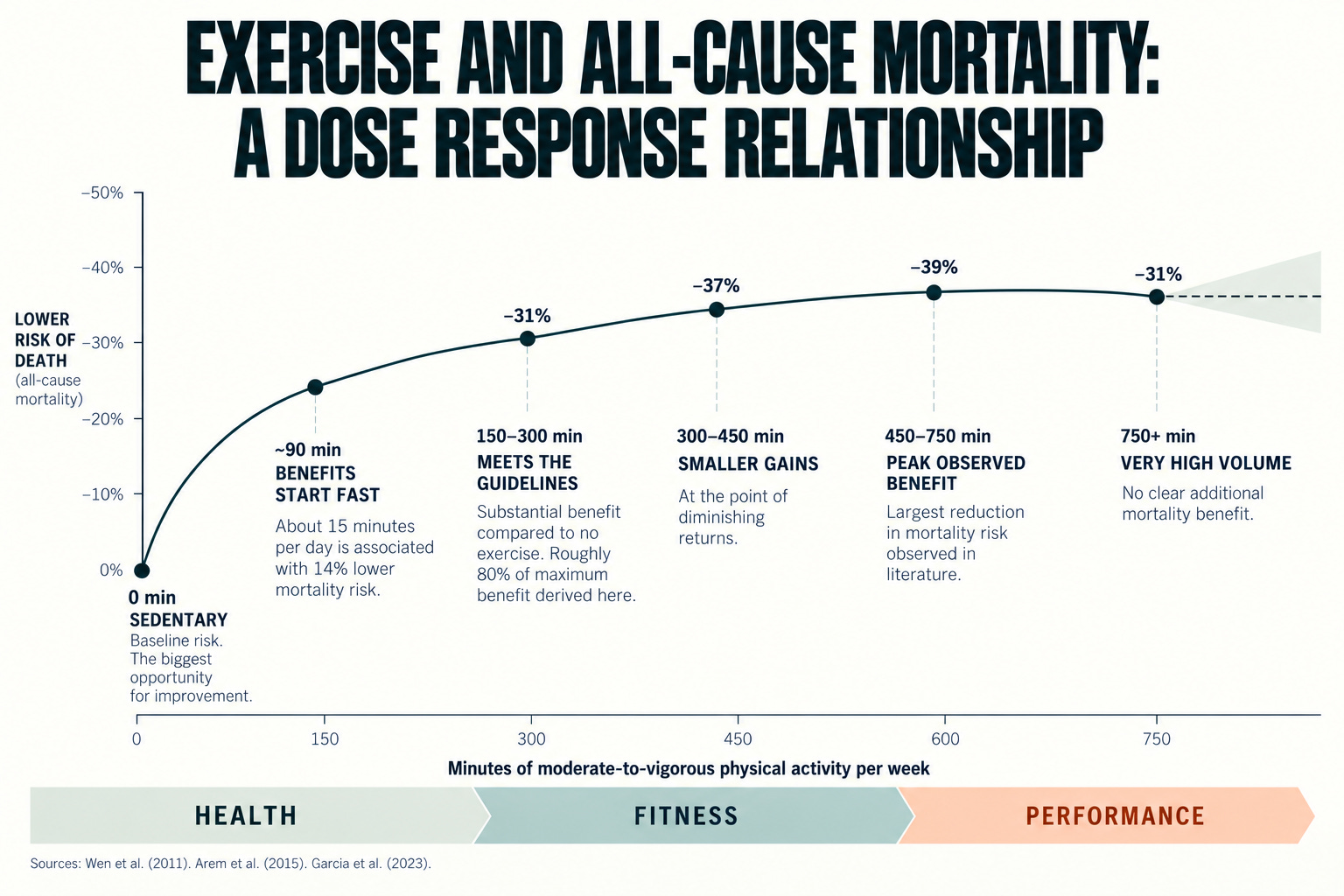
It is not just mortality. Garcia et al. found cardiovascular disease mortality was 29% lower and cancer mortality 15% lower when exercising 150 mins/week. That paper also estimated that if we brought every inactive person up to the guidelines, we could avert nearly 1 in 6 premature deaths.
Another way to analyze this data is by years rather than by percentages. Epidemiological cohorts suggest regular activity adds roughly 2 to 3 years to life expectancy.
Takeaways
The guideline dose (150-300 mins per week) captures most of the benefits that exercise offers. Everything beyond that is a smaller bonus for much more work.
Why cardiorespiratory fitness matters more than activity level.
So far this newsletter has looked at measures of input. For example, how many minutes per week? But what’s more important than minutes of exercise is what those minutes did to your physiology.
Cardiorespiratory fitness is the output we care about. Often expressed through VO2max, it reflects your body’s demonstrated capacity to take in, transport, and use oxygen. The numbers go from modest to extraordinary when you view the longevity question through this lens.
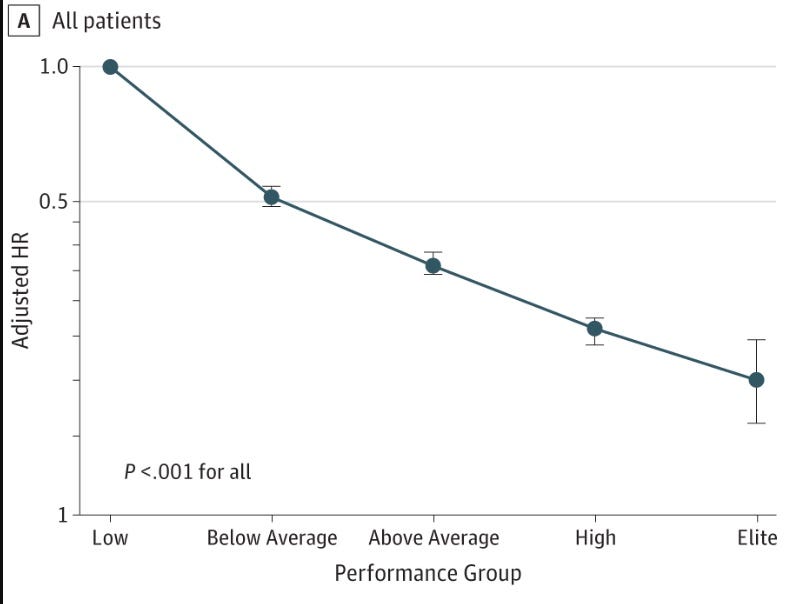
In 2018, a study from the Cleveland Clinic published data on 122,007 patients who underwent exercise treadmill testing and were followed for a median of 8.4 years. They sorted everyone into fitness bands by age and sex-adjusted percentiles and tracked who died.
Patients in the lowest fitness quartile had roughly five times the all-cause mortality of the top performers. In other words, the fittest group carried an 80% lower risk of death than the least fit.
That is hard to conceptualize in the abstract, so it helps to put those numbers next to known conditions. Each of these compares people who have the condition to people who do not, within the same population:
High blood pressure: 1.2x the risk of death compared to those without
Diabetes: 1.4x the risk of death compared to those without
Smoking: 1.4x the risk of death compared to non-smokers
End-stage renal disease: 2.8x the risk of death compared to those without
Being in the bottom fitness quartile instead of the top: 5.0x the risk of death
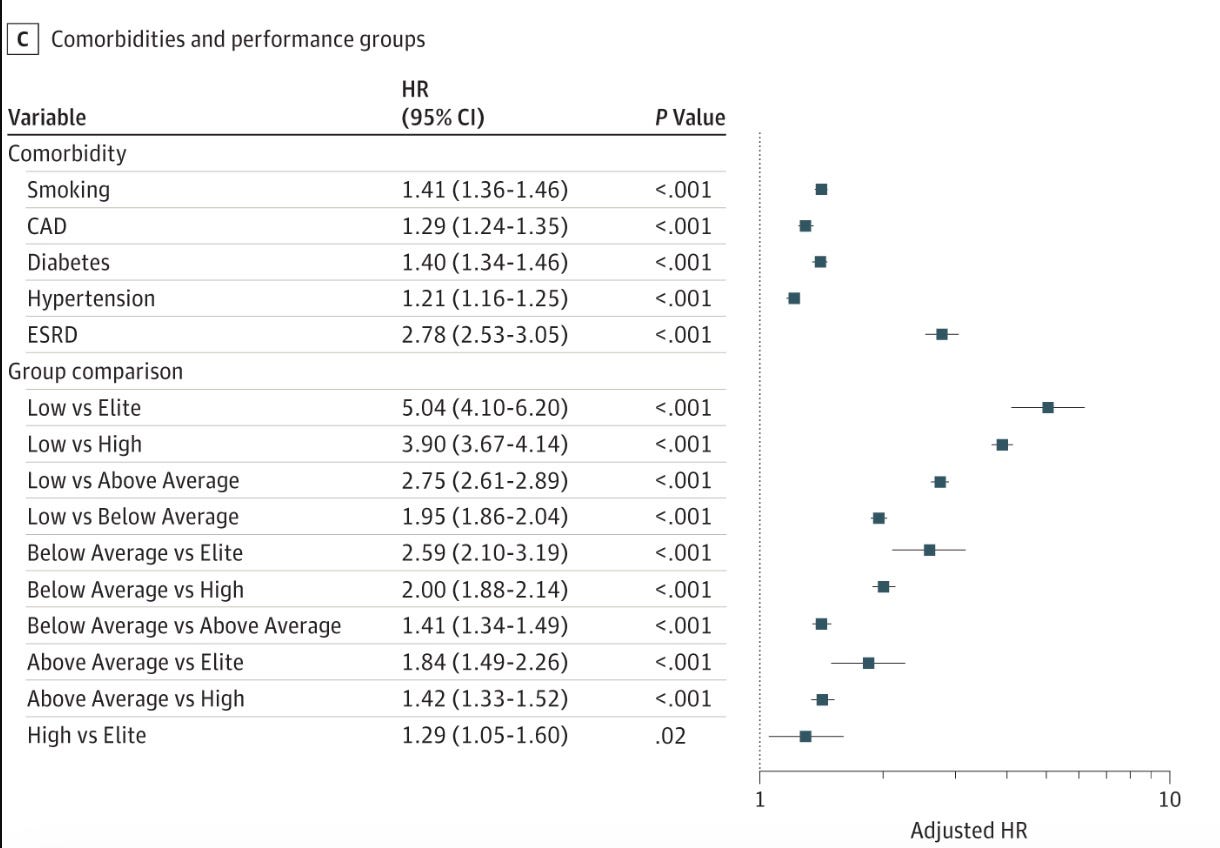
This is observational data, and we cannot claim low fitness causes more death than kidney failure. But the sample is enormous, the adjustments are reasonable, and the direction is not in question. Low fitness is not a “soft” risk factor sitting alongside the real ones. It is the largest modifiable risk factor we can measure.
You do not have to be near the top for this to matter. Moving a single band, from below average to above average, changed mortality risk by about the same magnitude as smoking versus not smoking.
Why would fitness be so protective of all-cause mortality?
Cardiorespiratory fitness (often measured as VO2max) is not simply a risk factor. It is a report card on the entire machine.
Every risk factor you think of (cholesterol or hypertension) offers clues about a specific body system.
VO2max is different. To move a large volume of oxygen from the air into working muscle and back out as carbon dioxide under maximum strain, everything from your lungs, heart, vessels, and muscles has to work at top gear without faltering.
That makes VO2max less like a single biomarker and more like a stress test of the entire system. Few measurements integrate the function of so many organs at once.
Are you running more than you need to?
Not everyone reading this will reach the top percentile for VO2max, but almost everyone is exceeding the US activity guidelines.
We have established that the mortality benefit asymptotes not far beyond that. So it is fair for a runner to ask whether there is an issue with doing five or ten times the minimum. Most of us are acutely aware of overuse injury risk, and some of you will have seen the headlines about cardiac risks in endurance athletes doing excessive volumes, particularly atrial fibrillation.
I’ll tackle this question in a future newsletter. My short answer is that some exercise is clearly good and more exercise is probably better. Yes, certain risks go up with volume. But they are offset by every other risk that goes down.
There is a more interesting problem with optimizing around the guidelines, though: simply not dying is a low bar. All-cause mortality tells you less about whether you can carry groceries up stairs or play with your grandchildren at 80.
One study recruited 70 participants across three groups: lifelong exercisers aged around 75 who were still training for roughly 7 hours per week (3x the guidelines), sedentary 75-year-olds, and 25-year-old exercisers. The lifelong exercisers had cardiovascular fitness comparable to healthy adults 30 years younger, and muscle capillary density and aerobic enzyme profiles that looked like the 25-year-olds’.
The inescapable fact is that your VO2max will decline. The Baltimore Longitudinal Study of Aging followed 810 adults with repeated treadmill testing and found that peak VO2 declined only 3% to 6% per decade in the 20s and 30s, then accelerated steadily, exceeding 20% per decade after 70.
In that study, the acceleration showed up regardless of physical activity habits. You can't opt out of the slope. What you get to choose is where the slope declines from.
Takeaways
Staying alive and staying independent into older age are different goals, and the second one may require more than what the guidelines recommend.
Fitness will decline with age; that is inescapable. But you can change how much of it you have when the decline starts.
Conclusion
Those of you running 70 miles a week are not doing it exclusively for the health and longevity benefits. You banked most of those a long time ago. You do it for the goals, the purpose it gives the week, and the people you do it with.
An athlete training only to reduce mortality risk has little reason to chase copious volumes of endurance exercise. Most of that benefit is captured early. But training for fitness, function, and independence points them at a different target.
Runners should know what the evidence says. But I doubt that every time you lace up your shoes, you are thinking about a 39% reduction in all-cause mortality. That is not why anyone runs, and it does not have to be.
Alex it sounds like I’m going to live forever then… jokes aside good read!
yeah we run for something beside just health for sure. it is a nice side effect though :-) thanks Alex, appreciate the research you put into these blogposts