


In 1979, Sebastian Coe and Steve Ovett were arguably the two best middle-distance runners in the world.
As the story goes, Coe went out on Christmas morning and did a hard 12-mile run. He came home and had Christmas lunch with his family, but afterward, sitting around, he couldn’t relax.
He kept thinking about Ovett. Eventually, he realized what was bothering him: Ovett was probably training again. Later, Coe recalled thinking, “I bet that bastard Ovett’s out there doing his second session of the day.”
So he put on his training gear, went back out into the cold, and did another session, including hill repeats.
Years after their competitive careers were over, Coe told Ovett the story, presumably expecting him to appreciate how much the rivalry had motivated him. Ovett reportedly responded, “You only trained twice that day?”
This isn’t simply a story about sacrifice. It’s also a story about what Coe feared. He didn’t go back out purely because he loved running. He went back out because he couldn’t tolerate the possibility that someone else was doing more.
That’s the harsh reality of high achievement. It comes with a cost. Elite performers are rarely peaceful and content. More likely, they’re tortured by the fear of being outworked.
The price of winning
Nobody wants to just win once. Maintaining a persistent competitive advantage requires an unreasonable amount of effort, and that effort is usually supported by paranoia.
The idea isn’t mine. Andy Grove, who ran Intel for a decade, wrote a book called Only the Paranoid Survive, and he laid out the sequence plainly: Success breeds complacency. Complacency breeds failure. Only the paranoid survive.
Most athletes follow that sequence exactly. The best ones recognize that the moment you feel safest is often when you’re the most vulnerable. To win repeatedly, you have to be paranoid precisely when it seems the least necessary.
Running is close to a winner-takes-all market. The margin between good and great is narrower than it seems. You might win by 1% or 1 second, and yet you capture 100% of the victory. A slight edge doesn’t give you slightly more. It gives you everything.
The problem is that paranoia tends to soften after victory, and once it goes, success paradoxically kills winners in two different ways. One is the death everyone warns you about. The other is far less expected.
Death One: Hubris
In theory, the person on the mountaintop should never lose. They have the most resources, the best perspective, and every defensive advantage.
But history doesn’t show that. Startups with minimal resources disrupt industries and topple behemoths that dominated for years. Unknown NCAA athletes make Olympic teams at the expense of established pros.
After winning, the first thing that gets in our way is our ego. Overconfidence and arrogance replace the scrappy mentality that got you to the top in the first place.
A famous saying in organizational management goes, “Nothing fails like success.” Success is a lousy teacher. It convinces smart people they can’t lose. Nothing blinds someone to the possibility of failure like success.
This is why, as a coach, I’m usually okay with a subpar season opener. When the goal race is 8 to 12 weeks out, the last thing I want is an athlete with an inflated ego after dominating their first race. That’s how complacency creeps in. The best mentality after a season opener is to leave hungry for more. I want a little paranoia. That’s what fuels the training through the crucial block.
Death Two: The undisciplined pursuit of more
This type of killer is more insidious. It applies only to people on the summit, which, by definition, is a much smaller percentage of climbers.
The second threat is overreaching. Once someone has tasted success, it convinces them to expand into areas they have no business operating in.
This is called the Peter Principle. In the workforce, talented workers keep getting promoted until they’re eventually in over their heads, and then they fail. People rise to the level of their incompetence.
In 2019, an economic study analyzed this phenomenon in 40,000 salespeople across 131 firms. In corporate America, companies often promote high performers in subordinate roles into management. This study confirmed that trend, then tracked what happened to performance afterward.
Better sales performance predicted worse managerial performance. Doubling someone’s pre-promotion sales was associated with roughly a 6% decline in each subordinate’s sales once that person became a manager.
Organizations promote people who excel at job A into job B. The problem is that job B requires a different skill set.
I see the same thing in my own coaching practice. After a successful year, pro athletes get swarmed with opportunity. Every race director is calling their agent to get them into a higher-profile race, dropping incentives like appearance fees that are hard to turn down. The carefully considered plan takes a backseat to a never-ending victory tour. Endorsement deals come flying in. Every performance product wants them to wear their device or take their supplement. Very quickly, the main thing stops being the main thing.
Success buys you options and opportunities. Those same options are what can undermine your future success.
Two different skill sets
Winning once and winning again require two different skill sets. One gets you to the top, the other keeps you there.
Reaching the top requires offensive drive and risk-taking. Staying there requires risk management and maintaining extreme focus.
The hard part is that no athlete stays in one position. Everyone ebbs and flows between the hunter and the hunted, sometimes inside a single season, which means you’re always running two operations at once: protecting the position you’re in and building towards the athlete you’re becoming.
Guarding both flanks
Here are a few practices I have learned as an athlete and coach that protect against both killers.
Never “talk down” an opponent. You gain absolutely nothing from underestimating your opponent. A lot of times people will say, “Oh, we’re way better than those guys. It’ll be an easy win” That language should be outlawed. This is the cheapest way to guard against hubris.
Never get too high or too low. As Steinbeck once said, “greatness lives in the one who triumphs equally over defeat and victory.” Keep a steady hand on the wheel at all times. Elite performers only let winning take them out of the process for a moment.
The 48-hour rule. In competitive seasons, you can enjoy a victory or wallow in defeat, but only for 48 hours. After that, you must get back to work. That puts everything in perspective. The work doesn’t change nearly as fast as our emotions. Win or lose, there are still miles to run.
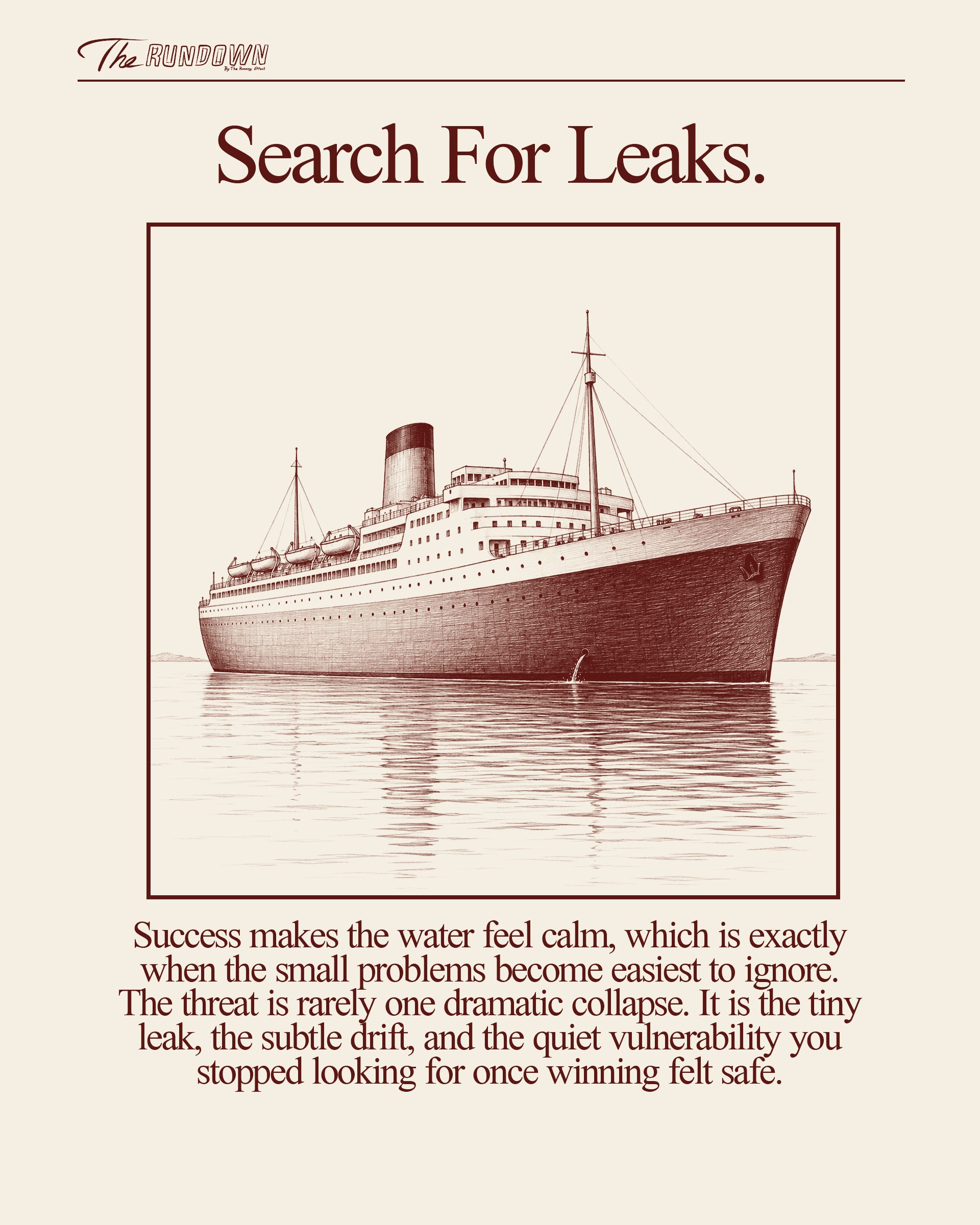
Search for leaks. As Machiavelli said, “It is in human nature when the sea is calm not to think of storms.” But a small leak will sink a great ship. Careers don’t evaporate overnight. It’s usually a slow deterioration that’s hard to notice from the inside. After success, it’s counterintuitive to audit for vulnerabilities, but you must.
Conclusion
If you want to win once, you can probably do so with peace and contentment. If you want to dominate a field, you need to productively channel paranoia and keep scanning for threats.
But the scanning needs to change direction. Coe spent Christmas afternoon worried about a man in another city. That fear kept him locked into an arms race, each competitor attempting to subdue the other with more work.
The threats that end careers don’t always live in another city. They’re the extra race you said yes to for the appearance fee. The effective training strategy you abandoned because you thought you’d outgrown it. The honest feedback you stopped hearing once you started winning.
The paranoia that got you to the top was pointed at your competition. The paranoia that keeps you there has to be pointed at yourself.
Great insight! Those whom competed in the pre internet world can relate to Seb/ Ovett. My Ovett was Melvin Thompson in my Senior Year of High School in 1978. I knew he was putting in 60 plus miles a week so I went out many times and hammered a 5-7 mile run at 5:30-5:50 pace to counter.
great info but interesting word, "paranoia" I wonder if there might be another way to frame it. I think of Gebreselassie and his big smile. I wonder if he had the paranoia thing? not sure, just wondering