


As a coach, I’ve given something up that feels close to sacrilegious. I’ve largely stopped giving detailed race plans in championship races.
Here’s the problem: a race plan is a hypothetical projection. You factor in statistical probability, game theory, weather, health, a rival’s last race outcomes, and it comes out as a script for an event that hasn’t happened yet.
As a coach, you intend for that plan to have flexibility. But most athletes don’t want it to go mostly right. They want it to go exactly right.
And the moment the race deviates from the projection, the plan expires. If the race plan goes out the window at 400 meters, the athlete doesn’t just lose a strategy. They feel robbed of one. Instead of immediately solving the race in front of them, they spend precious time grieving the race they expected.
Ideally, a plan would be built at the point of maximum information, when the pace, conditions, and competition are no longer projections but discoverable facts. If runners wore earpieces, coaches could plan in real time, but we don’t. Unlike most other sports, the point of maximum information is also the point of zero coachability.
So I’ve stopped investing in prediction and started investing more in preparedness. I’d rather teach and encourage skills that hold up no matter how the race unfolds.
A Case Study on Mindset: How Klaudia Conquered the 1500
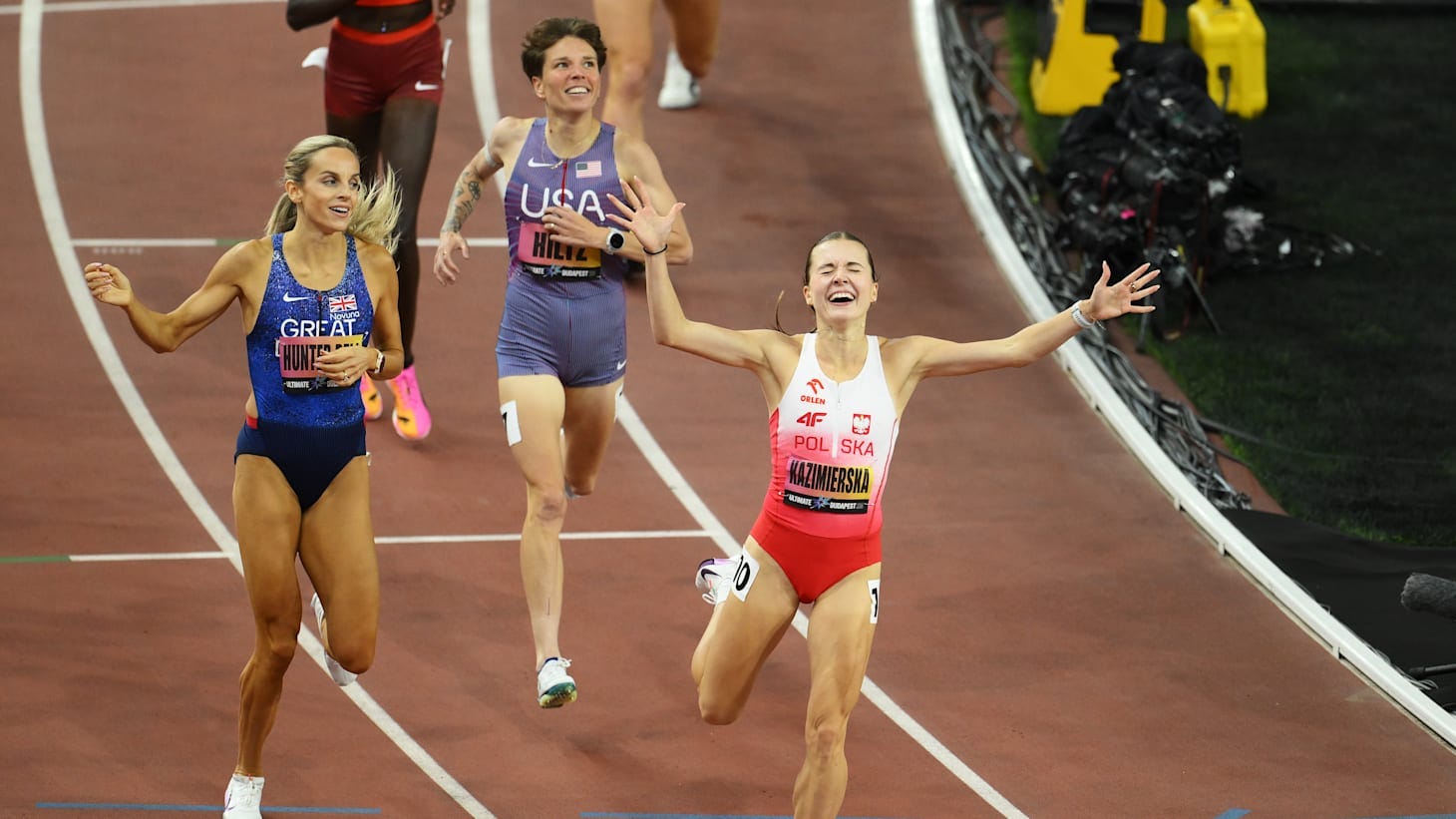
This dawned on me while watching Klaudia Kazimierska’s summer racing campaign.
I’ve coached Klaudia alongside Jerry for the past year, and watching her recent progress has been tremendous. Each race has become a stepping stone. For me, the inflection point came after the World Indoor Championships, held in her home country of Poland.
After she qualified for the 1500 final, Jerry and I spent hours on the phone going over race scenarios. We landed on one we liked the most. Have her take the lead after the halfway mark and wind it up every 100m from the front. We put a real premium on being at the front on the indoor track when the race started rolling; even if she got outkicked, she’d be outkicked from medal position. We talked her through other scenarios, but preferred this one.
Then, when the race started, Birke Haylom took it out in 62s for the first 400m, stringing out the field, leaving Klaudia in the chase pack. Our ideal race plan had evaporated. Caught flat-footed in what turned into a time trial, surrounded by women with faster personal bests, she finished a disappointing sixth.
Six months later, she has put together one of the most remarkable stretches of 1500m racing in the world. She has won the Diamond League final, the Ultimate Championships, and the Athlos mile within the past few weeks.
What has changed? Her fitness has definitely improved. And when a race is fast enough, superior fitness can beat even the most savvy tactician. She also hasn’t mastered one race format. She’s won from the front, the back, and in a dead heat down the homestretch.
She still walks to the line with a loose plan. But it carries less weight. When a plan deviates, she bends instead of breaking. She pivots quickly, and then goes back to instincts and mindset. Besides refining a few tactical moves, if you watch any recent interviews with her, she’ll talk mostly about how her last few races really came from a shift in competitive mindset.
Mindsets Travel Better
The lesson here isn’t that all race plans are useless. Klaudia still walks to the line with a loose plan. But it’s really only useful when the race unfolds as expected. The more specific a plan becomes, the more ways it can break. Mindsets travel better. They are useful whether the pace is fast or slow, you feel incredible or terrible, or you’re fighting for first or 50th.
That’s why I’ve become less interested in scripting races and more interested in preparing athletes to respond. Here are four mindsets worth practicing.
Never take yourself out of the fight
So many runners concede before the race is even started. They look at the pre-race projections and mistake them for a ceiling. If you have any shred of evidence that you belong with the best, use it. Don’t disqualify yourself early.
Jeff Johnson, one of Nike’s first employees who also coached, once shared what he told one of his best athletes before a race:
“In any race, 20% of the field will defeat themselves with nerves, 20% are overtrained, and another 15% are badly trained. 15% will run stupid races, and 10% will be slowed by injury or illness. That leaves, roughly, one of five runners ready to run solid races. Half of those are not as good as you are, and the other half is no better than you are. So I like your chances.”
The field on paper is almost never the field you’ll have to beat. Some athletes will misjudge the race. Some will have bad days. Others will miss the move. If you stay in the hunt for long enough, the intimidating field from the starting line gets considerably smaller.
Kill the “perfect day” fallacy
Any time an athlete starts using magical language to describe a great race from the past, I remind them that humans are very good at editing adversity out of our memories. We misremember the past as better than it was. You remember the PR, but you forget the side stitch halfway. You forget that you slept 3 hours the night before, tossing and turning with nerves.
That selective memory becomes dangerous because when those things happen again, you assume you’re dead in the water. We overreact to imperfections while forgetting how many we’ve already overcome.
Anytime an athlete has a good race, I remind them of the adversity that they overcame along the way. “Add that to the mental bank,” I’ll say. You’re building evidence that imperfection and performance can coexist.
I spend a lot of time teaching athletes to sever the connection between feeling great and performing great. You don’t need ideal conditions. When something feels off, don’t waste energy trying to figure out what it means. Give 100% of whatever capacity you have on that day. That’s all you can ask of yourself.
Save your best decisions for when they matter most
Early in a race, your job is to preserve options. A longer cannot be won in the first mile. It absolutely can be lost there.
The mistake athletes make isn’t just spending too much physical energy early on. It’s spending too much emotional energy. They fight unnecessarily for position, cover moves that don’t matter, or ride the adrenaline of the opening minutes for too long. When they reach the decisive part of the race, they’re running on fumes. You can’t save bad early decisions with brilliant late decisions.
Positioning at the start matters, but the second half decides outcomes. In college, Coach Milt insisted that we become a “second-half team.” Most runners do the opposite. The second half of a race becomes damage control. They have no response when the adrenaline fades.
If you can genuinely re-engage when everyone else begins disengaging, the race changes quickly. You’re suddenly competing against people who have stopped competing.
Don’t spend emotional energy early in a race on things that aren’t yet decisive. Preserve your options until you know where to deliver your knockout punch.
Run the race in front of you
Every runner carries some vision of how they want the race to unfold. Then the race punches them in the mouth.
It’s remarkable how much energy we waste clinging to an old expectation instead of solving the problem directly in front of us. Respond to what is actually happening, not emotionally to what you wish were happening.
When races get tough, I conceptualize this as a band that stretches and snaps. When someone starts struggling, they’ll often try to hang on to the runners ahead as if connected by an elastic band. The band stretches 10, then 20, then 30 meters. Some athletes keep fighting as it stretches. Their goal might slip away, but their resolve doesn’t.
Others let the band snap immediately. A small setback becomes permission to abandon the race entirely. When people give up, they tend to fail with abandon. One bad mile becomes a bad race. One missed move becomes an excuse to stop making any moves at all. A minor problem cascades into a catastrophe.
Elite performers are exceptionally good at containing the damage. Something can go wrong without everything going wrong.
Conclusion
You cannot predict which race you’re going to get. You can decide which athlete shows up to meet it.
So carry a plan to the starting line, but hold it loosely. The goal isn’t to predict what happens next perfectly, but to be prepared for whatever happens with the right mentality.
Super article as usual and huge congrats on Klaudia’s season. However, to describe Jeff Johnson as an “early Nike employee who also coached” diminishes his incalculable impact in both areas :)! I know I’m not alone in saying 30 years on, his coaching influence still lives in my own daily approach.
In swimming, your thesis has a formal structure: prelims, semifinals, finals. A 400 freestyle campaign is not one script — it is a different script per round, and the final often expires at the first wall. A swimmer can hold split targets to the 150 and then watch the field go, at which point the only decision that matters is one the plan couldn't contain: stay with the field and pay for it late, or hold your race and risk letting the medals swim away.
What championship swimming adds to your "preparedness, not prediction" point is that the best swimmers rehearse the decision points, not the splits. Before a final they know their move if the first 100 is two seconds fast, or if the leader dies at the 300. The mindsets travel; the scripts are disposable.
And the races keep confirming it: the great championship 400s and 1500s are rarely won by the swimmer who executed a plan — they are won by the swimmer with the biggest last-100 differential, the one whose preparation included the race going wrong. The plans that survive contact are just the ones with the widest error bars.