


Almost every fitness influencer who posts a morning routine includes an electrolyte powder. It’s hard to spend any time on social media without hearing that “plain water doesn’t hydrate you” and that most of us are walking around chronically dehydrated. Supplement companies have been remarkably good at convincing athletes that starting the day without a scoop of salt means you’re depriving yourself.
The marketing has worked. In a study of 344 endurance athletes from English-speaking countries, most believed sodium was critical: 75% expected it to prevent cramping, and 69% thought they should replace sodium losses during training.
The scientific literature and human physiology tell a different story.
The conventional logic for electrolytes goes like this: you sweat → sweat contains salt → losing salt must create a deficiency → replacing what you lose must improve hydration and performance. The first two steps are true. The last two don't hold up nearly as well.
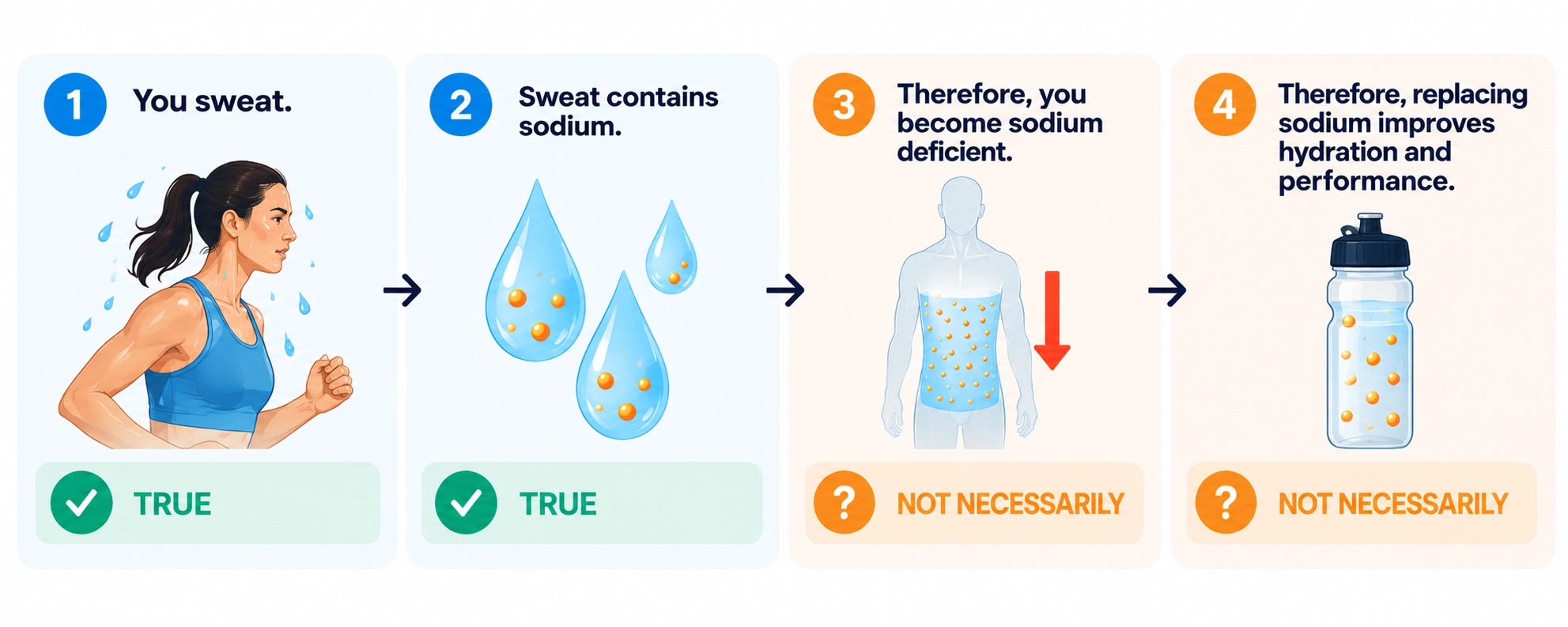
My goal in this newsletter is to separate what the research supports from what the marketing claims.
Overview of the physiology
Your body keeps the sodium concentration in your blood within a narrow range (135 to 145 mmol/L), but that number depends on both sodium and water. Think of it like soup: you can make it saltier by adding salt or boiling off water.
Your body has a finely tuned system for holding that range. When your blood becomes too concentrated, you get thirsty and release antidiuretic hormone (ADH), which tells your kidneys to conserve water. When your blood becomes too dilute, ADH drops, and your kidneys increase urine production.
The system has enormous capacity. Your kidneys filter about 180 L of fluid a day and reabsorb more than 99% of the sodium that passes through, with the hormone aldosterone fine-tuning how much they keep. If you eat more salt, your kidneys tend to release more into the urine. If you lose salt through exercise, your body holds onto it.
Because of this, intake and losses don’t need to match milligram for milligram, hour by hour.
There’s also a key difference between total body sodium and plasma sodium. Total body sodium is the overall amount of sodium you carry, much of it outside your bloodstream, in the fluid around your cells and in bone. Plasma sodium is the concentration of sodium dissolved in your blood.
You can lose a meaningful amount of total body sodium without your plasma concentration budging because the body keeps shifting water and sodium between these compartments to protect that concentration.
For exercising athletes, sweat is much less salty than blood. That means sweating removes proportionally more water than sodium, so counterintuitively, as you sweat, your plasma becomes more concentrated (panel 2, below).
Drinking water replaces the fluid and pulls sodium concentration back towards normal (panel 3).
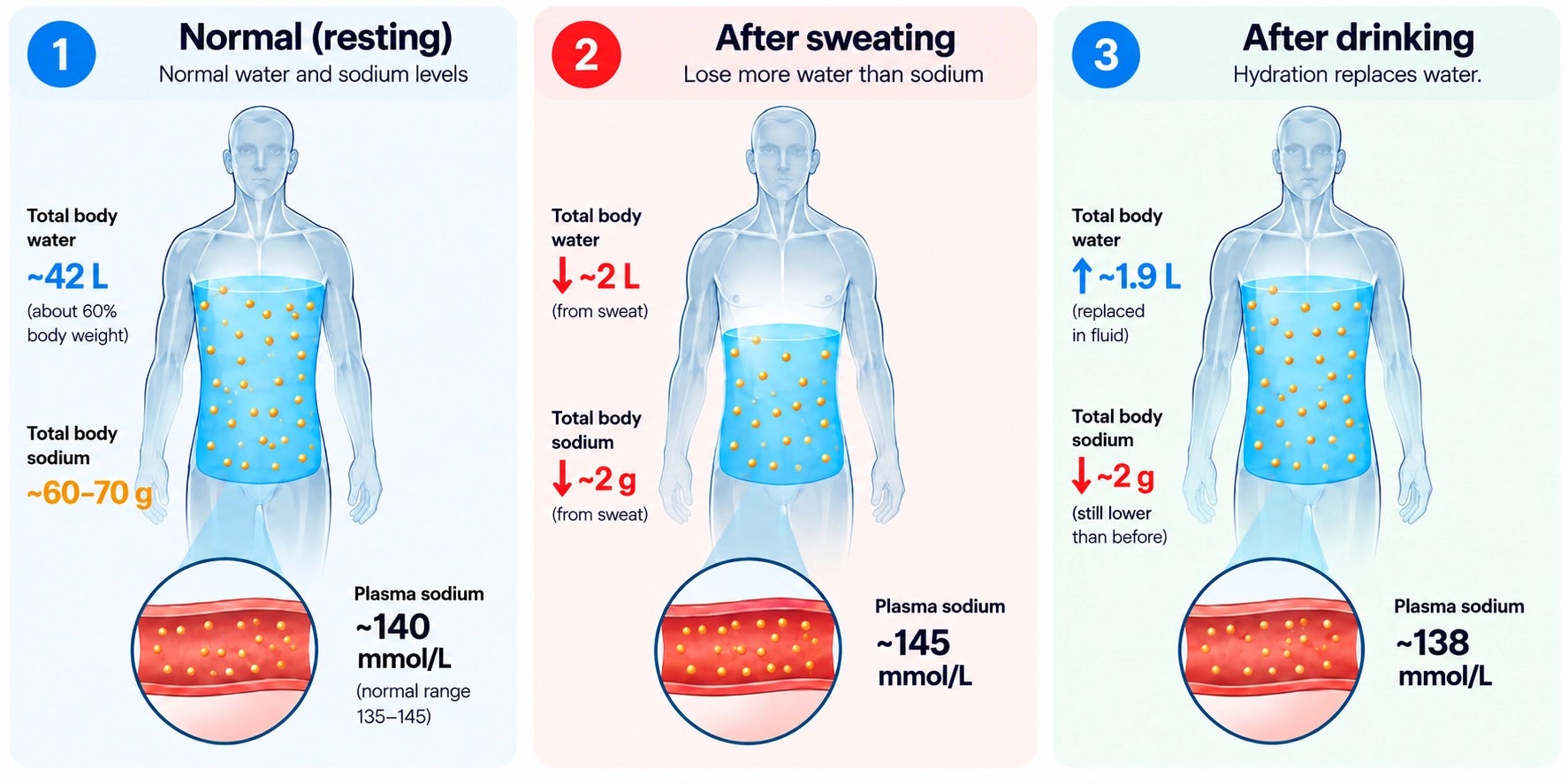
If you replace a small fraction of your sweat losses by drinking, plasma sodium stays normal or elevated. As you replace a larger fraction, sodium matters more because you’re restoring water without restoring sodium.
With that foundation in place, here are the key takeaways from my read of the literature.
Takeaway #1: You’re probably already eating enough electrolytes
As I discussed in a recent newsletter on protein, a food-first approach solves most sports nutrition problems. Athletes forget that food is an electrolyte supplement. Bread, cheese, sauces, soups, and prepared foods are loaded with sodium. Potassium and magnesium come from fruits, vegetables, nuts, dairy, and whole grains. For sweat losses, sodium is the most important electrolyte, so this newsletter focuses on it.
Sodium intake also correlates with energy intake. The more you train, the more you eat, and the more sodium you consume without trying. The US Dietary Guidelines recommend less than 2,300 mg of sodium per day for the general population. One study of runners, cyclists, and triathletes found they averaged about 3,900 mg per day, some as high as 6,600 mg, without any added supplements.
To be fair, the guidelines aren’t always applicable to athletes, but most get plenty from food. The exception might be athletes who are chronically underfueled or cook everything entirely from scratch.
Takeaway #2: A sodium deficit is not a problem on its own
Your body is not a static bucket of water and salt. If you sweat 1 L containing 1,000 mg of sodium (this varies a lot between people), you don’t owe your body 1,000 mg of sodium back. You can finish a run in a negative sodium balance with a perfectly normal blood sodium concentration. The body tolerates this surprisingly well.
In one remarkable study, runners completed two 5-hour treadmill runs at 86°F, drinking to thirst. In one trial, they received sodium capsules that replaced 100% of their sweat sodium losses; in the other, a placebo. In the placebo trial, the average sodium deficit was 5,658 mg (about 8.5% of total body sodium), the largest I’ve seen in the literature. Yet thirst, fluid intake, heart rate, core temperature, and RPE did not differ between the two conditions.
Takeaway #3: Sodium helps primarily through its interaction with water
Sodium isn’t a direct performance enhancer, fuel, or stimulant like caffeine or carbohydrate. In one controlled trial, 700 mg of sodium per hour during a roughly 3-hour cycling time trial increased thirst but did nothing for performance compared to a placebo. One trial on triathletes found a performance benefit from sodium supplementation, but this came alongside better fluid balance. No study I’m aware of has convincingly shown a performance benefit from sodium independent of its effects on fluid balance.
When sodium does matter, its benefit comes from influencing how much you drink and how much of that fluid you retain.
When you drink plain water, it dilutes the sodium in your blood. Your body senses that dilution, turns down thirst, and ramps up urine production. Once it decides it has enough water, the kidneys get rid of the excess.
Adding sodium changes that equation because water follows sodium. It limits that dilution, so thirst stays switched on and the kidneys are less eager to dump the water you just drank. You drink a bit more and keep more of it.
Therefore, sodium’s benefit is indirect. During longer hot efforts where a runner might otherwise underdrink, it nudges them to drink and hold on to an appropriate volume of fluid.
Takeaway #4: Hyponatremia doesn’t appear to be a salt-shortage problem
At the extreme, drinking more than you lose through sweat can dilute your blood sodium enough to cause a dangerous condition called exercise-associated hyponatremia. Sodium supplementation has not been shown to prevent it when someone keeps overdrinking. The Wilderness Medical Society identifies overdrinking as the principal modifiable risk factor.
This creates a strange paradox: a 4-hour marathoner following an aggressive hydration plan can be at greater risk of hyponatremia than a 2-hour marathoner. The slower runner spends twice as long on the course, can afford to stop at more hydration stations, and may sweat less, especially if race day turns out cooler than expected. They end up putting water in faster than they sweat it out.
One Boston Marathon study found exactly that. Runners finishing slower than 4 hours had 7.4 times the odds of hyponatremia compared with those finishing under 3:30, and gaining weight during the race was one of the strongest warning signs.
So when does sodium matter?
Four interacting factors determine whether a sodium strategy matters for you: duration, sweat rate, sweat sodium concentration, and the percentage of fluid losses you replace.
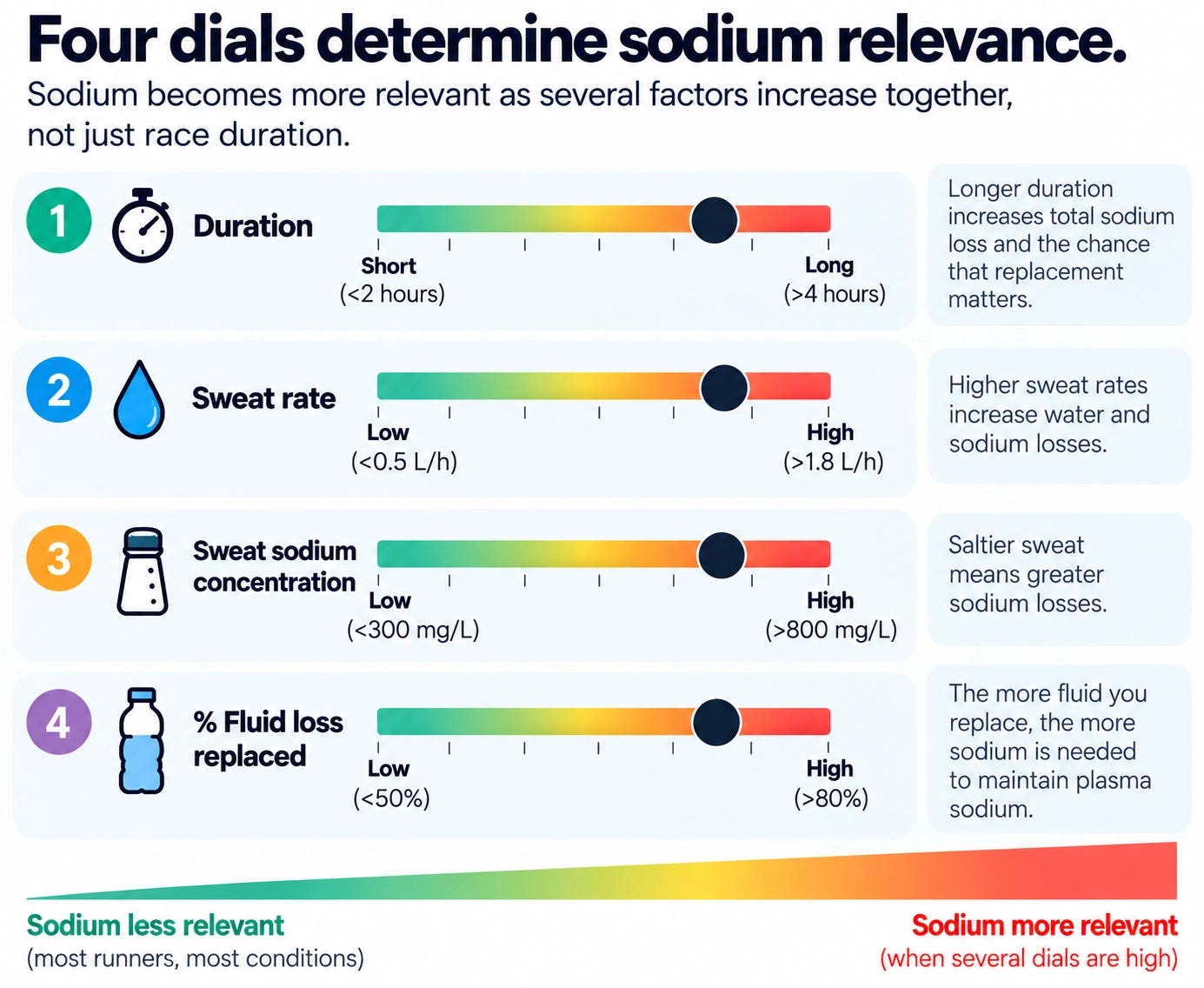
The first three dials felt intuitive as I researched this topic. I had no idea the fourth dial mattered. A lot of the sodium conversation hinges on a single number: 70%.
During most runs, your blood sodium concentration rises unless you drink back more than about 70% of your sweat losses. Once you cross that line, blood sodium can start to fall. If you’re drinking plain water alone, hyponatremia becomes a real risk. To help athletes decide whether they need a targeted sodium strategy beyond “seasoning to taste,” sports dietitian Dr. Alan McCubbin proposed three questions (with my commentary in italics) in this extremely comprehensive paper:
Would you benefit from replacing more than 70% of your fluid losses? Usually not. Many runners can lose 2 to 3% of body weight in fluid without a meaningful drop in performance, though the exact threshold is still debated. For most runs under about 4 hours in moderate conditions, sweat losses are usually modest enough that replacing less than 70% is fine.
Can you tolerate drinking that much? Your gut has limits. Few runners can handle drinking more than 1L of fluids at race pace, and most drink much less. If you can’t drink that volume, your fluid replacement stays below 70%, your blood sodium stays stable or rises, and you don’t need to worry about targeted sodium.
Is it practical within the rules and logistics of your event? Even if your gut could handle it, executing it on a course is a different story. If aid station spacing or carrying capacity keeps you under 70%, your body’s own mechanisms will defend your sodium for you.
If you answer yes to all three, consider a sodium strategy and a sweat composition test. Frustratingly, I can't give every runner a scientifically defensible number. Recommendations vary, commonly somewhere in the 300 to 600 mg/hour range, but getting more specific takes trial and error, ideally with guidance from a sports dietitian.
If the answer to any of these three questions is no, your sodium will stay stable on its own, and you can stick to the Golden Rule: season your food and drinks to taste. No calculated plan required.
For a comprehensive decision tree I created based on the evidence, download the document below.

Conclusion
Sodium is an important electrolyte, but its use case is much narrower than the marketing suggests. You can get a sweat test if you’re curious, but for most runners, seasoning food and drink to taste is enough.
If you’re an electrolyte aficionado, I’m not going to fight you on it. This is an area where anecdotes are especially convincing, partially because electrolytes tend to come bundled with other things that help. A runner who felt much better after starting an electrolyte drink may have also consumed more fluid, taken in more carbohydrate, and eaten more overall. The electrolytes may get the credit, but the sodium probably isn’t what made the difference.
I’m a tennis player and have taken to eating a salty snack before I play but this is making me think it is probably mostly the carbs and calories that improve my playing. I’ve always only had plain water but have sometimes wondered if I should be drinking something else, but this has reassured me that water is probably fine.
Thanks for busting some myths about sodium and other electrolyte needs Alex. Definitely helping me rethink a few things.
I would highly recommend a listen to Dr Alan McCubbin talking about his 2023 study you refer to, on his Fuelling Endurance podcast, episode 71. He also explores this topic more recently in Episode 99 - How much sodium should I take before, during, and after exercise?
https://open.spotify.com/episode/7f47SHufveCmiuAprIAYg5?si=9e70dbc738474c21